
How natural gas moves from the source to the people and places that depend on it.
Natural gas is part of everyday life, but most people only see the final step of the journey. They see a meter outside a home, a boiler in a school building, or equipment running inside an industrial facility. The full path is much bigger.
Natural gas moves through a connected system before it reaches the end user. It may start at a production site, move through gathering lines, pass through processing, travel long distances through transmission pipelines, enter a local system at a city gate station, and finally move through distribution lines, service lines, and customer connections.
Each stage has a job to do. Each transition matters. Each piece of infrastructure plays a role in helping natural gas move safely and reliably to the people, businesses, and communities that count on it.
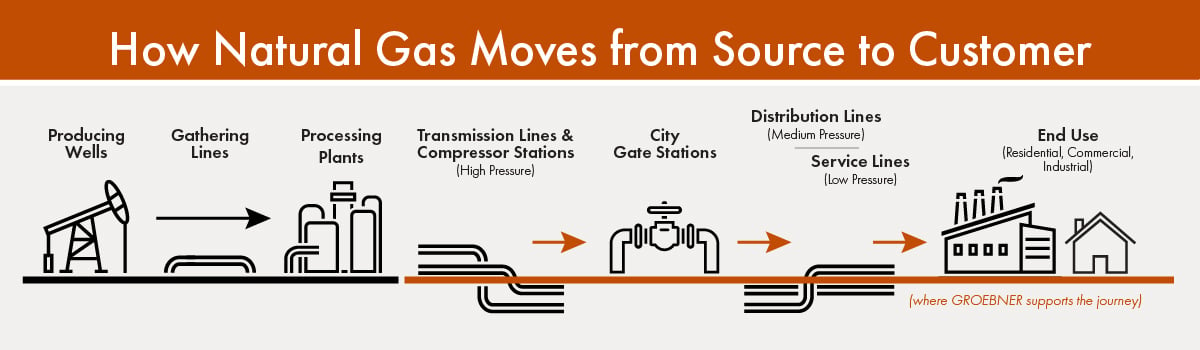
(1) Producing Wells: Where natural gas begins
The natural gas journey begins at the source. Natural gas is found underground in rock formations and is brought to the surface through wells. Some wells produce mostly natural gas. Other wells produce natural gas along with crude oil and other hydrocarbons.
Natural gas can also enter a system through imports. The United States imports and exports natural gas mainly by pipeline as a gas and by ship as liquefied natural gas (LNG). Small amounts may also move as LNG or compressed natural gas by truck.
Once natural gas is produced, it is not always ready to move directly into the larger pipeline system. It often needs to travel first through gathering infrastructure and then through processing.
(2) Gathering Lines: Moving gas from the field
Gathering systems collect natural gas from production areas and move it toward processing facilities or larger pipelines. These systems help bring gas from multiple wells or production points into a more centralized flow.
This stage is important because production areas are often spread out. Gathering lines help connect those individual sources into the larger natural gas network.
The gas at this point may still contain water vapor, hydrocarbon gas liquids, and other components that need to be removed or managed before the gas can move into long-distance transmission pipelines.
(3) Processing Plants: Preparing natural gas for the pipeline system
Natural gas processing helps prepare gas for movement through the main transmission system. Processing plants separate water, nonhydrocarbon gases, and hydrocarbon gas liquids from the natural gas before it is delivered into a transmission pipeline.
This part of the journey is sometimes casually described as “refining,” but “processing” is the more accurate term for natural gas.
Processing helps produce pipeline-quality gas. It also helps separate valuable natural gas liquids, depending on the composition of the gas stream. Once the gas meets the required specifications, it can move into the transmission system.
(4) Transmission Lines: Moving gas over long distances
Transmission pipelines are the long-distance highways of the natural gas system. These pipelines are often wide-diameter, high-pressure lines that move natural gas from processing areas toward storage facilities and distribution centers.
Transmission lines may operate within one state or across state boundaries. Interstate transmission pipelines move gas across state lines, while intrastate transmission pipelines operate within a state.
This stage is built for volume and distance. Gas may travel hundreds or even thousands of miles through transmission infrastructure before it reaches the next major transition point.
Compressor or booster stations may also be used along transmission systems to help maintain pressure and keep gas moving through the pipeline network.
(5) City Gate Stations: The transition into the local system
The town border station, often called a city gate station, is a major handoff point in the natural gas journey.
This is where gas typically moves from a high-pressure transmission system into a local distribution system. City gate stations often include metering and pressure regulation, and they may also include filtration and odorization depending on the system design and where odorant has already been added. Metering and regulating stations help reduce pipeline pressure so gas can be delivered safely through the distribution system.
This stage matters because the needs of the system change. Transmission pipelines are designed to move large volumes over long distances. Local distribution systems are designed to deliver gas through communities, neighborhoods, business districts, and service areas.
The city gate station helps make that transition possible.
(6) Distribution Lines: Delivering gas through local systems
Distribution lines move natural gas from the city gate station into the communities and service areas where customers use it. These lines are part of the local delivery network and are often operated by a local distribution company (LDC), municipal gas system, or utility.
This is where much of the day-to-day gas utility work happens.
Distribution systems include pipe, fittings, valves, tracer wire, and other components that help move gas safely and reliably through local infrastructure, often at medium pressure before it is regulated further for customer use. This work may include new installations, maintenance, repairs, replacements, tie-ins, emergency response, and service changes.
Much of what GROEBNER does supports this part of the journey with field-ready solutions for distribution work. Crews need dependable materials, tools, and equipment. They also need partners who understand what is at stake when service is interrupted, conditions change, and the work still needs to move forward.
(7) Service Lines & Meters: Connecting the system to the customer
Distribution mains bring gas through a service area. Service lines, often operating at lower pressure, carry gas from the main to an individual customer location, such as a home, school, business, or industrial site.
This is where above-ground and below-ground infrastructure meet. Risers and transition fittings help create dependable connections between different materials, environments, and installation points, including the transition from below-ground pipe to above-ground meter set connections.
The meter set measures gas use and helps manage delivery to the customer. Depending on the application, pressure may be regulated again before gas enters the customer’s equipment or facility.
This stage brings the natural gas journey closer to the people and places that depend on it every day.
(8) End Use: Residential, commercial, and industrial
The final stage of the journey is the end user. Natural gas may serve many different types of customers, including:
- Households
- Schools
- Hospitals
- Restaurants
- Businesses
- Industrial facilities
Residential customers may use natural gas for space heating, water heating, cooking, clothes drying, or fireplaces. Commercial and institutional customers may use natural gas for heating, hot water, kitchens, laundry, boilers, or building operations. Industrial customers may use natural gas for process heat, manufacturing, drying, curing, steam generation, or other operational needs.
This final stage is easy to overlook, but it is the reason the entire system exists. Every pipeline, tool, and connection helps support reliable service to the homes, businesses, and facilities that rely on natural gas.
Why the Full Journey Matters
Natural gas work is not just about one pipe, one fitting, one meter, or one repair. It is part of a larger system.
A decision made in the field can affect installation quality, service reliability, maintenance needs, customer experience, and long-term system performance. That is why understanding the full natural gas journey matters.
The journey helps show how each part of the system connects:
- Production brings natural gas out of the ground.
- Gathering systems move it from the field.
- Processing prepares it for pipeline transportation.
- Transmission lines move it over long distances.
- City gate stations transition it into the local system.
- Distribution lines carry it through communities.
- Service lines and meters connect it to the customer.
- End users depend on it for heat, hot water, operations, comfort, and daily life.
Each stage has a purpose. Each stage depends on the others.
GROEBNER Understands the Job, Not Just the Parts
GROEBNER supports those who work across the natural gas system, helping connect product knowledge, field experience, and practical support to the work happening every day.
Crews do not just need products. They need the right products for the job, backed by people who understand how and where those products are used.
That is the bigger picture behind the natural gas journey. It is not only about how gas moves from the source to the end user. It is about the work that happens along the way, the people responsible for keeping systems moving, and the support that helps them do the job with confidence.
Need support for your next natural gas project? Talk with GROEBNER to find the right products and solutions for the work ahead.